For years, “payer mix risk” largely meant patients moving among insurance products: a little more Medicare Advantage, a little less commercial coverage, and some churn on the exchanges. It was uncomfortable, but manageable.
This quarter, three of the country’s largest for-profit health systems described something different across three separate earnings calls. Patients are not simply moving between plans. They are becoming uninsured.
The mechanics are simple, but the implications are difficult to absorb. When a patient loses exchange coverage, the balance does not disappear with the plan. It moves. The insurer stops being the payer, and the patient becomes responsible, often for an amount that was never structured for one person to carry alone.
The financial impact is already significant
Across three of the country’s largest for-profit health systems, exchange coverage losses showed up differently in second-quarter results. But the underlying pattern was consistent. Patients losing coverage continued to need care, while a greater share of the financial responsibility shifted to the patient.
The largest impact came from a system that had expected a meaningful share of patients leaving exchange plans to transition to employer-sponsored coverage. Instead, leadership said those patients migrated almost one-for-one to uninsured status.
Other systems reported similar exchange pressure, including rising uninsured volumes and concentrated declines in states including Florida, Texas and Arizona.
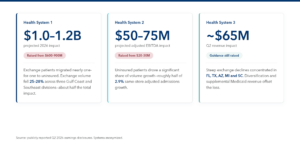
The differences between the three systems are as instructive as the similarities. One expects a $1.0 billion to $1.2 billion full-year impact. Another lowered guidance as its expected ACA-related EBITDA impact more than doubled. The third absorbed approximately $65 million of revenue impact in the second quarter yet still raised guidance, supported by a more diversified ambulatory business and supplemental Medicaid revenue.
That is not a reason to discount the trend. It’s a preview of which organizations may be better positioned to absorb it. Systems with less diversification – or greater exposure to markets experiencing sharp exchange declines – may feel the shift more directly on the bottom line.
The exposure extends beyond the earnings call
State-level enrollment data suggests the exposure is broader and, in some areas, more severe.
Ohio’s exchange enrollment fell from 497,443 to 336,058 between February 2025 and February 2026. That represents a 32.4% decline, roughly three times the national decrease of approximately 10%. Oklahoma and Arizona followed closely, with declines of 30% to 32%.
Approximately 161,000 Ohioans lost exchange coverage in 12 months, yet none of the three systems highlighted Ohio on its earnings call. The states generating the headlines are not necessarily the states generating the balances.
What health systems can do now
Patients do not stop needing care when they lose coverage. They simply stop being covered for it. For health systems, responding to that shift requires more than treating a growing uninsured population as an increase in traditional self-pay.
Identify newly uninsured patients earlier. Not every patient who loses exchange coverage is uninsurable. A meaningful share may qualify for Medicaid or financial assistance.
The operational challenge is identifying those patients early enough to connect them with available coverage or assistance before their balances age into bad debt.
Many financial engagement workflows were designed for a predominantly insured population. As coverage patterns change, health systems need to recognize changes in insurance status earlier in the patient journey and determine the appropriate financial path before the account simply moves into a standard self-pay workflow.
Treat self-pay as a segment, not a status. For patients who are genuinely self-pay, the financial equation has changed. Balances are larger, and a flat, one-size-fits-all collection strategy designed around insured patients does not reflect what a newly uninsured patient can realistically sustain.
Health systems can respond by better understanding differences within their self-pay population and aligning payment options with patients’ individual financial circumstances. The objective should not simply be to collect a larger balance. It should be to establish a realistic path to resolution.
Adapt engagement to the new financial reality. A patient who expected insurance to cover much of their care may suddenly face a balance they never anticipated carrying alone. How and when the health system communicates in that moment matters.
Timing, communication channel, messaging and payment-plan structure can all influence whether a patient understands their options and takes action. Making financial assistance and payment choices easiser to understand and access can help organizations engage patients before balances become increasingly difficult to resolve.
The uninsured shift is not a future risk to include in next year’s planning. It is already visible in the results of three of the country’s largest health systems. If an organization’s exchange exposure resembles that of Florida, Texas, Arizona, or Ohio, the effect may already be present, even if it is not yet apparent in top-line volume.
The health systems best positioned to respond will be those that can quickly and precisely determine which newly uninsured patients qualify for other coverage or assistance, and create a sustainable financial path for those who do not.